You want to know if you can trust the calorie burn and targets MacroFactor gives you, especially in that first month when the numbers keep moving. Fair question. If the estimate is off, your whole plan is off.
FeastGood may earn a commission from links on this page.
Short answer: yes. If you log consistently, MacroFactor’s estimate is one I’d trust. I think MacroFactor is the best nutrition app on the market, and it’s the one I use. The catch is that its estimate is only as good as what you give it. It works out your burn from what you log and how your trend weight moves, and it usually settles after two to four weeks.
By then, MacroFactor’s team found the median error was 135 calories a day. That’s their own number, though, and I couldn’t find any independent study testing MacroFactor’s expenditure estimate.
This covers MacroFactor’s current expenditure algorithm (V3) on iOS. I haven’t checked the Android app.
Check Out MacroFactor App Start with a free 7-day trial plus an extra week with code FEASTGOOD.
If you’re curious, here’s how we review nutrition apps.
Key Takeaways
- MacroFactor estimates your calorie burn from your logged intake and the change in your trend weight. The first estimate is a formula guess that settles over about 2–4 weeks.
- MacroFactor’s own analysis of 748 users found a median error of 135 calories a day after 3–4 weeks. It isn’t peer-reviewed, and it left out people who regularly half-logged.
- Log at least 4 of every 7 days and weigh in at least 3 times a week, though daily is better. A half-logged day hurts more than a rough estimate.
How MacroFactor Estimates Your Calorie Burn
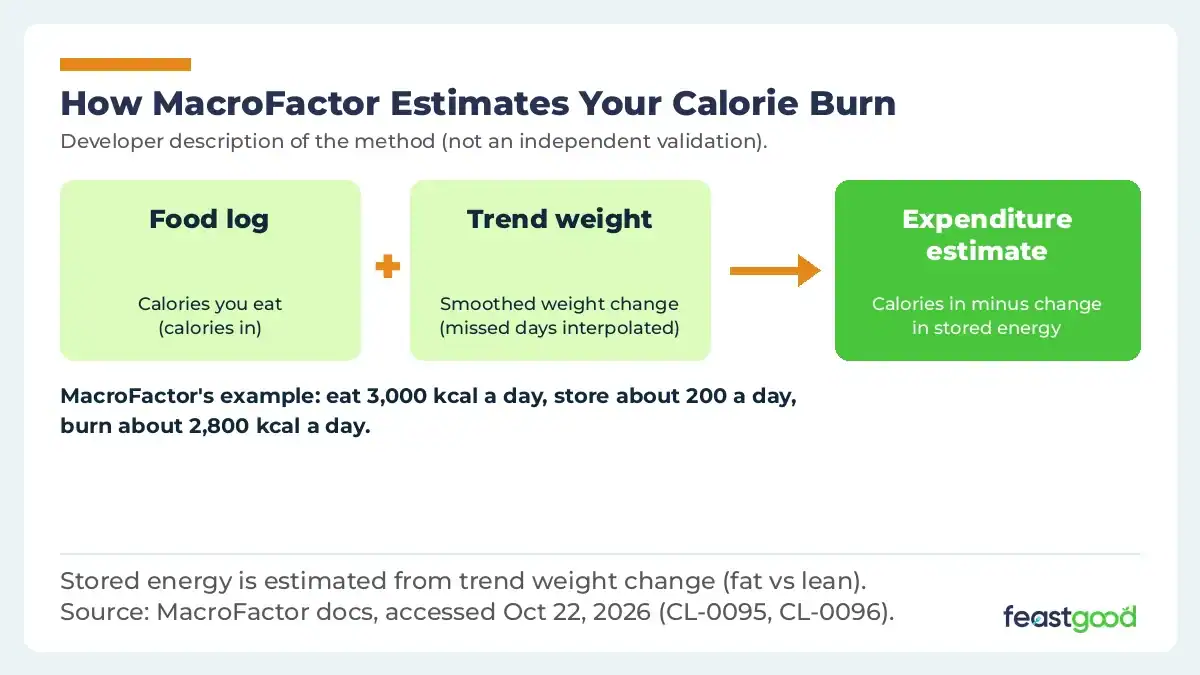
The idea is simple. The app looks at how many calories you eat, based on your food log, and how your body weight changes over time. From those two things it works out how many calories you’re actually burning.
Put another way, the calories you burn equal the calories you eat, minus whatever your body stored or pulled out of storage. MacroFactor reads that storage change from how fast your trend weight is moving, and it accounts for the fact that fat and lean tissue hold different amounts of energy.
Here’s the example MacroFactor uses. Say you eat 3,000 calories a day and your trend shows you’re storing about 200 calories a day. Your burn comes out to roughly 2,800 calories.
It works the other way too. If you log 2,200 calories a day and your trend weight is dropping about half a pound a week, you’re burning more than 2,200. That’s just a made-up example to show the direction.
Trend Weight, Not Daily Weight
Your scale weight jumps around from water, food in your gut, and other short-term swings. MacroFactor smooths that out into a trend line, so one salty dinner doesn’t wreck your numbers. If you skip a weigh-in, it fills the gap by drawing a straight line between the days on either side. You can see what this looks like in the app in my MacroFactor guide.
Why the First Weeks Move Around
On day one, MacroFactor has no history on you, so it starts with a standard formula estimate. That first number will be off for most people, some more than others, and that’s expected.
The estimate starts updating within the first few days, starts moving noticeably after about a week, and usually settles somewhere between two and four weeks. So if your target jumps in week two, the app isn’t broken. It’s learning.
So How Accurate Is It?
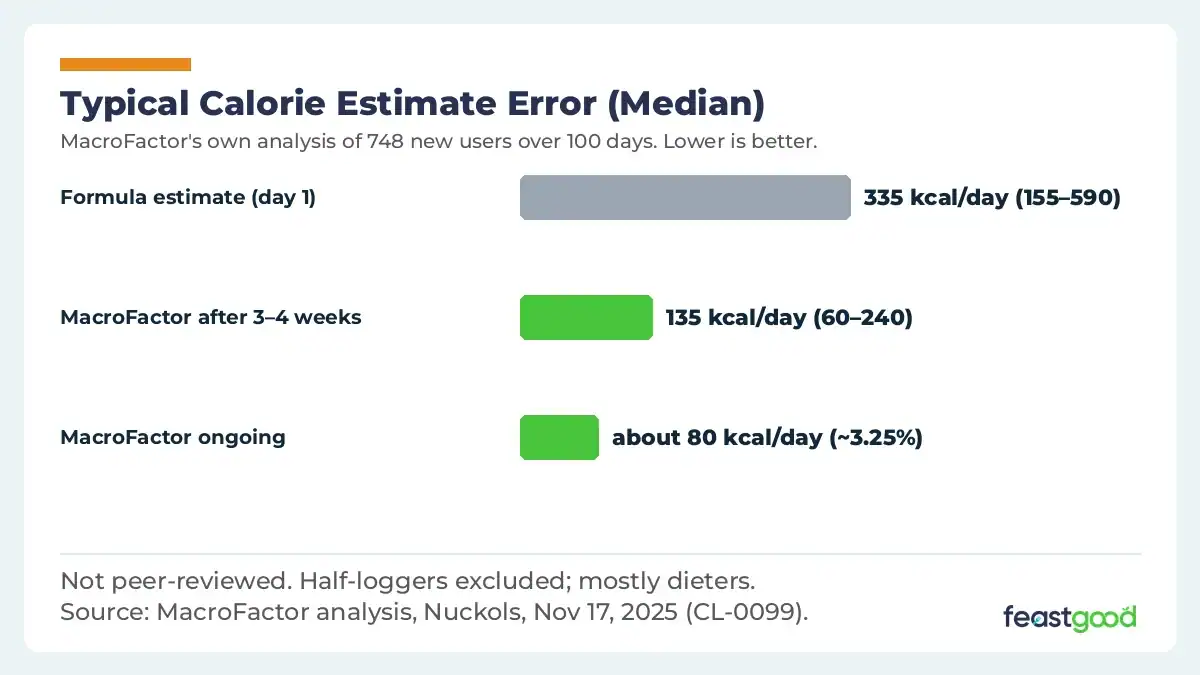
MacroFactor’s team tested it on 748 new users over 100 days. After 3–4 weeks, the typical error was 60–240 calories a day, with a median of 135. Standard formula estimates missed by 155–590 calories, with a median of 335.
Once the estimate has calibrated, the ongoing median error is around 80 calories a day, which is about 3.25% of a typical burn.
| Stage | What MacroFactor uses | Typical error |
|---|---|---|
| Day 1 | Formula estimate | Median 335 kcal (155–590) for formulas |
| After 3–4 weeks | Intake + trend weight | Median 135 kcal (60–240) |
| Ongoing | Same, still updating | About 80 kcal/day (~3.25%) |
MacroFactor’s own, non-peer-reviewed analysis of 748 users; partial loggers excluded.
Those are good numbers, but you should know their limits:
- It isn’t peer-reviewed. MacroFactor ran the analysis on its own app.
- People who regularly half-logged were left out. That makes the results look better than they would for everyone.
- The sample was mostly dieters. It came from a transformation challenge, so the results may not carry over exactly to everyone.
It also wasn’t checked against a lab measurement of burn. Instead, MacroFactor looked at how well its estimate predicted people’s actual weight change.
Has Anyone Tested It Independently?
Not that I could find. Until someone runs one, treat the accuracy figures above as the company’s own.
Is the Method Itself Sound?
Yes. Working out burn from intake and weight change has been tested in a lab. In a small study of 24 adults, this approach landed within 0.3% of doubly labelled water, the gold-standard way to measure burn. The catch is that the researchers measured what people ate. Nobody was logging in an app.
That matters, because people are bad at self-reporting. A review of 59 studies found most self-report methods came in well under real intake, and food records were 11–41% low.
Here’s the good news: your weight trend doesn’t depend on your log, so the app has a reality check built in. What it can’t handle is a day where you log half your food and stop.
What Throws It Off
The biggest thing is partial days. Say I log breakfast and then stop logging for the day. I obviously ate more than that, but the app thinks breakfast was all I had. It runs its math on that number, and the estimate drifts.
A few other things matter too:
- The starting guess. Your first estimate comes from a formula, so it’ll be off until your data catches up.
- Too few weigh-ins. The trend needs enough points to smooth out the noise.
- Too little logging. If you log fewer than 4 of 7 days, the V3 algorithm pauses instead of guessing.
- Bad food entries. Nothing frustrates me more than taking the time to log everything and having the numbers be off. If the database isn’t accurate, what’s the point?
How to Give MacroFactor Better Numbers
- Log every day you can. If you can’t, a rough estimate (within about 30%) beats a blank day, and a blank day beats a half-logged one. A day logged as zero gets ignored unless you mark it as a fast.
- Weigh in daily if possible, and at least 3 times a week. Use the same scale, in the morning, after the bathroom, in minimal clothing.
- Use the quick option instead of skipping. Some days I just don’t want to search for every food and adjust portions. Having a fast way to log is often the difference between logging and giving up.
- Pick label or verified entries, and weigh your food. For food without a label, here’s how to count calories without labels.
- Give it 2–4 weeks before you judge it. Early swings are normal.
For more on how the app works day to day, see my full MacroFactor review.
Who Should Trust MacroFactor’s Numbers?
- You’ll log most days and weigh in regularly: trust the estimate as a starting point. It’ll correct itself as you go.
- You log on and off, or stop halfway through the day: fix the logging first, or the numbers won’t settle.
- You want a free app: MacroFactor has no free tier. Check out my picks for the best calorie trackers for beginners, my list of MacroFactor alternatives, or MacroFactor paid vs free.
Verdict: Is MacroFactor Accurate?
If you log consistently, MacroFactor’s estimate is a solid, self-correcting starting point. Just treat the accuracy numbers as the company’s own. If you want to see how it stacks up as a tracker overall, here’s my best macro tracking app roundup.
MacroFactor costs $11.99 a month, $47.99 for six months, or $71.99 a year. There’s a 7-day free trial and no free tier. Prices are as of October 22, 2026.
Check Out MacroFactor App Start with a free 7-day trial plus an extra week with code FEASTGOOD.
References
- MacroFactor. Expenditure; Weight Trend; How should I interpret changes to my energy expenditure; Expenditure version (help center).
- MacroFactor. MacroFactor’s algorithms and core philosophy; Algorithm accuracy (updated Nov 17, 2025).
- Seale JL, Rumpler WV. Comparison of energy expenditure measurements by diet records, energy intake balance, doubly labeled water and room calorimetry. Eur J Clin Nutr. 1997;51:856–863.
- Burrows TL, et al. Validity of dietary assessment methods when compared to the method of doubly labeled water. Nutrients. 2019. PMC6928130.