If you’re lifting hard and wondering whether a “muscle” supplement can add anything on top of your training, Transparent Labs has two candidates: Growth and Build.
They couldn’t be more different. Growth is just one ingredient, phosphatidic acid, at a dose that’s actually been studied. Build is a stim-free blend of five ingredients aimed at endurance and recovery.
So which one deserves your money? And do you need either one?
Below, I’ll break down what’s in each, how the doses stack up against the research, what they cost per day, and who should buy which. (Here’s how we review products.)
FeastGood may earn a commission from links on this page.
The short answer: Pick Growth if you’re a trained lifter and you want one ingredient that’s been studied at the same dose, even though the evidence is limited. Pick Build if you want a cheaper, stim-free blend for endurance and recovery, just know the research on its ingredients used higher doses, different products, or different people. And skip both if your training, protein, and creatine aren’t dialed in yet.
Check Growth price | Check Build price
Key Takeaways
- Growth has one active ingredient: 1,500 mg of Mediator phosphatidic acid (PA), which yields 750 mg of PA per serving. That matches the dose in the most positive study, but the evidence comes from a few small trials.
- Build is a five-ingredient blend: PeakO2 (2,000 mg), epicatechin (150 mg), elevATP (150 mg), AstraGin (50 mg), and SenActiv (50 mg). I can’t point you to a solid study on Build or its exact branded ingredients at Build’s doses. The closest research (Cordyceps-containing mushroom blends, green tea extract) used higher doses or different people, and the rest is marketing.
- Cost per day: Growth is $2.00 ($1.80 subscribed). Build is $0.83 at one scoop or $1.67 at two.
- Both products are stimulant-free.
Quick Comparison
| Product | Best for | Key actives (per serving) | Servings | Price (one-time / subscribe) | Cost per day | Stimulants | Forms | Link |
|---|---|---|---|---|---|---|---|---|
| Transparent Labs Growth | Trained lifters focused on strength and size who accept limited evidence | 1,500 mg Mediator PA (750 mg PA) | 30 | $59.99 / $53.99 | $2.00 ($1.80 sub) | None | Powder (3 flavors, incl. Unflavored) or capsules | Check price |
| Transparent Labs Build | Stim-free, endurance/recovery-leaning lifters on a tighter budget | PeakO2 2,000 mg; epicatechin 150 mg; elevATP 150 mg; AstraGin 50 mg; SenActiv 50 mg | 60 (1 scoop = 5.8 g) | $49.99 / $44.99 | $0.83 at 1 scoop; $1.67 at 2 ($0.75 / $1.50 sub) | None | Powder (2 flavors) | Check price |
Prices are as of October 13, 2026, and can change. Check the current price before you buy.
What Each Product Is
Both are sold as “muscle” supplements, but they take completely different routes. Growth bets on one ingredient. Build spreads its formula across five branded ones.
Transparent Labs Growth
Each serving has 1,500 mg of Mediator phosphatidic acid, which works out to 750 mg of phosphatidic acid. That’s the whole active formula.
It’s stimulant-free, and it’s marketed as stackable with pre-workout, post-workout, protein, and creatine.
You’re supposed to take it 30–45 minutes before exercise or between meals, every day, for at least six weeks. That’s how to use it, not proof it works in that time.
Growth comes as a powder in three flavors, including Unflavored, and as capsules, at the same price either way.
What I Found Testing Growth
I’ve bought and tested every product Transparent Labs sells. With Growth, I paid attention to how it tastes and mixes, what it costs, and whether the science backs it up.
Honestly, my Growth test didn’t go to plan. I trained less often and less intensely than I wanted to.
Even so, I kept all my strength from the start of the month to the end. My at-home body fat analyzer didn’t show any real loss of muscle either, though I don’t trust it as a reliable measure.
That’s one inconsistent stretch, not a controlled test. It doesn’t show that Growth built muscle. I’d want a few more months with dialed-in training and nutrition before calling it.
See Growth on Transparent Labs
Transparent Labs Build
Build’s key ingredients per serving are PeakO2 (2,000 mg), epicatechin from green tea (150 mg), elevATP (150 mg), AstraGin (50 mg), and SenActiv (50 mg).
You get 60 servings per container. A scoop is 5.8 g, with 10 calories and 2 g of carbs.
The other ingredients are citric acid (1,310 mg), L-malic acid (1,000 mg), natural flavors, stevia (220 mg), calcium silicate (200 mg), silicon dioxide (200 mg), and beet root (100 mg).
Build is marketed as stimulant-free, naturally flavored, and sweetened with stevia.
You take one scoop in 8–10 oz of water 30–60 minutes before exercise, with an optional second scoop after your workout. That second scoop matters for the cost math.
Ingredients and Doses vs the Research
This is where the two really split. A supplement is only as good as how closely its dose matches what was actually studied, in people like you.
Growth: Phosphatidic Acid
Growth is sold on muscle protein synthesis, strength, and lean mass, citing four PA studies. That’s marketing, not independent proof, so let’s look at the trials themselves.
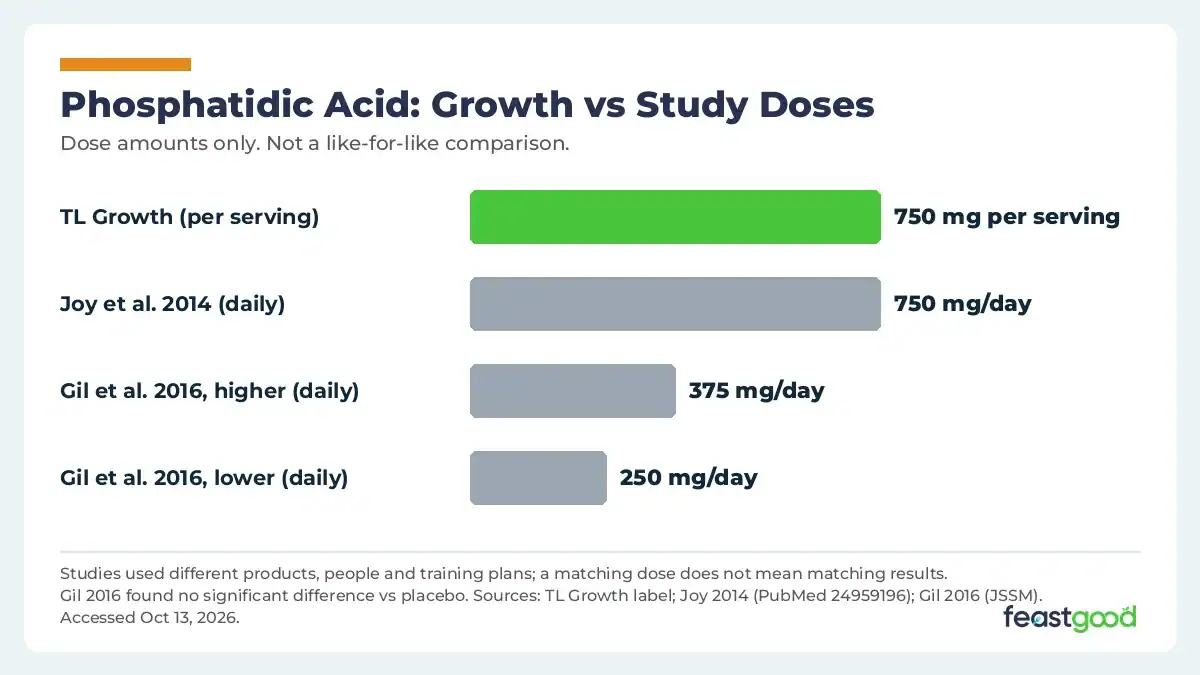
The most positive one is Joy et al. (2014). They randomly assigned 28 resistance-trained men to either 750 mg of PA a day or a placebo during eight weeks of structured training.
Compared with placebo, the PA group gained an extra 2.4 kg of lean mass, 1.0 cm more cross-sectional area in the front thigh muscle (rectus femoris), and 51.9 kg more on the leg press.
That’s a striking result, but the research here is thin: one small trial, some authors with industry ties, and only the study summary to go on.
The second trial points the other way. Gil et al. (2016) tried lower doses, 250 or 375 mg, for eight weeks of training and found no significant difference compared with placebo. Only a looser kind of statistical analysis leaned toward PA.
Bottom line: Growth’s 750 mg matches the dose in the most positive study, but the evidence is limited to a few small trials.
Winner on dose match: Growth.
Build: A Five-Ingredient Blend
Build’s marketing promises better endurance, performance, and recovery within one week, plus a VO2 max boost from PeakO2. That’s the brand’s promise, not proof, and the closest research used higher doses, different products, or different people.
PeakO2 (2,000 mg). Mushroom blends with Cordyceps have shown early, small-study signals at higher doses. In the one small study, about 10 people took an unnamed Cordyceps blend at 4 g a day for three weeks, and it’s only been published as a short conference summary.
That blend isn’t identified as PeakO2, and its dose is double Build’s 2 g. So it isn’t evidence for PeakO2 or for Build.
Epicatechin (150 mg). The human muscle trial gave adults 60 and older, who weren’t training, 600 mg a day of a specially treated green tea extract.
It did improve some strength measures. But that tells you very little about muscle growth in trained lifters, and 600 mg of extract vs 150 mg of epicatechin isn’t an apples-to-apples comparison.
elevATP, AstraGin, and SenActiv. I don’t have research on these three to point you to, so treat the marketing as marketing, not proof.
Verdict on Evidence
Growth matches its research better: its one ingredient sits right at the dose from the most positive trial. The evidence is still thin and mixed, though.
Build’s formula is broader, but I can’t point you to a solid study on PeakO2 itself, and the epicatechin trial isn’t a clean dose match. Those trials were also tiny or done in people who don’t look much like a typical lifter.
Check Growth price | Check Build price
Price and Cost Per Day
Here’s the math: divide the price by the number of servings in the container, then multiply by how many servings you take a day.
Growth – One-time: $59.99 ÷ 30 servings = $2.00 per day – Subscribe & save (10% off): $53.99 ÷ 30 = $1.80 per day
Build – One-time: $49.99 ÷ 60 servings = $0.83 per scoop – At the optional two scoops a day: $1.67 per day – Subscribed ($44.99): $0.75 per scoop, or $1.50 at two scoops
A container of Growth lasts 30 days. A container of Build lasts 60 days at one scoop, or 30 at two.
US orders over $99 ship free, and there’s a 45-day satisfaction guarantee with a refund or store credit. Terms change, so check them before ordering.
Winner on cost per day: Build, at one scoop. Even at two scoops it’s slightly cheaper than Growth.
Flavors, Forms, and Convenience
Growth gives you more options: a powder in three flavors, including Unflavored, or capsules if you’d rather not mix anything.
Build comes as a powder in two flavors. On October 13, 2026, stock for those flavors was inconsistent, so check availability before you order.
What I noticed with Growth: “unflavored” doesn’t mean tasteless. It’s far from it. The scoop is small, though, so I mixed it into my pre-workout on training days and my greens on non-training days, and I barely noticed it. Mixing it with protein worked too. Plan to mix it with something.
I don’t have testing notes on Build’s taste or mixing.
Winner on convenience: Growth, thanks to the capsule option.
Can You Stack Growth and Build?
Growth is marketed as stackable with other workout supplements, and both products are stimulant-free, so there’s no caffeine to double up on.
Stacking them just means paying for both: $2.83 a day with one scoop of Build at one-time prices, or $2.55 a day subscribed.
I haven’t seen evidence that the two work better together. Treat a stack as two separate purchases, each judged on its own evidence.
Who Should Buy Growth
Growth makes the most sense if you’re already a trained lifter chasing more strength and size, and you’re OK paying for an ingredient whose best support is one small trial.
If that’s you, Growth’s dose matches that trial. The directions call for daily use for at least six weeks.
Who Should Buy Build
Build fits if you want a stim-free product that leans toward endurance and recovery, and you want to keep daily costs down.
Just go in with realistic expectations. The research on its ingredients used higher doses, different products, or different people, and the one-week results promise comes from the brand, not a study.
Who Should Skip Both
I’d skip both if you aren’t yet training consistently, eating enough protein, and taking creatine. In my view, those basics are the better first spend.
Before I tried Growth, I considered creatine and HMB the “holy grail” of muscle-building supplements. If you’re still sorting out creatine, start with our guide to the best creatine for muscle building and how long creatine takes to work.
For protein, see our Transparent Labs whey protein review.
Drawbacks
Growth – The evidence is a few small trials, and the most positive one has industry-linked authors. – A lower-dose trial found no significant effect. – It costs more per day than Build. – Unflavored isn’t tasteless, so plan to mix it with something.
Build – I can’t point you to a solid study on PeakO2 itself; the related mushroom-blend research used double Build’s dose, and the epicatechin study used a different dose form. – The key trials were tiny or run in untrained older adults. – Three of the five ingredients have nothing behind them but marketing. – At the optional two scoops a day, the cost per day doubles.
Both – In my view, neither replaces the basics of training, protein, and creatine. – Prices, flavors, and stock change, so re-check them before buying.
Verdict
Growth’s dose lines up with its research better, even if that research is limited. Build is cheaper per day, but I can’t point you to a solid study on PeakO2 itself, and its other ingredients lack a clean study match. In my view, neither one replaces creatine and protein.
If you’re a trained lifter with the basics covered and you want to try PA, Growth is the more defensible pick. If cost and a stim-free endurance blend matter more, Build is the cheaper option.
Check Growth price | Check Build price
For more on the brand, see our Transparent Labs supplements hub. You can also read Transparent Labs Bulk review, Bulk vs Lean, Stim-Free vs Pump, and our Creatine HMB review.
References
- Joy et al. 2014. Phosphatidic acid RCT in resistance-trained men. https://pubmed.ncbi.nlm.nih.gov/24959196/
- Gil et al. 2016. Journal of Sports Science and Medicine. https://pmc.ncbi.nlm.nih.gov/articles/PMC4974867/
- Hirsch et al. 2015. Cordyceps-containing mushroom blend, conference abstract (JISSN 12 Suppl 1:P45). https://pmc.ncbi.nlm.nih.gov/articles/PMC4594151/
- Epicatechin (tannase-treated green tea extract) RCT in older adults. Antioxidants 10(7):1026. https://www.mdpi.com/2076-3921/10/7/1026
- Transparent Labs Growth product page (accessed Oct 13, 2026). https://www.transparentlabs.com/products/growth-mediator-phosphatidic-acid
- Transparent Labs Build product page (accessed Oct 13, 2026). https://www.transparentlabs.com/products/strengthseries-build
- Transparent Labs Build Fruit Punch supplement facts label. https://cdn.shopify.com/s/files/1/0866/7664/files/Build_-_Fruit_Punch_SFP.png