
If you want to lose weight, gain weight, or just finally know what you’re eating, tracking calories is the simplest place to start. It sounds tedious, but it’s easier than you think once you have a routine.
Tracking calories comes down to three things: know your target, weigh what you eat, and log it the same way every day. You don’t need to be perfect. You need to be consistent.
FeastGood may earn a commission from links on this page.
If you want an app that does the math for you, I recommend MacroFactor. It’s the best paid tracker I know of for beginners. It has a verified food database and a barcode scanner, and its weekly coaching adjusts your targets based on what you log and how your weight trends.
Check Out MacroFactor App Start with a free 7-day trial plus an extra week with code FEASTGOOD.
Below, I’ll walk you through my six-step logging routine, from reading a label to reading your weekly trend. If you’re curious, here’s how we review nutrition apps.
Key Takeaways
- Your calorie target is just a starting estimate. 2,000 calories is a general guide on food labels, but your needs depend on your age, sex, height, weight, and activity.
- Every number on a label is per serving, so check the servings per container and weigh your portion.
- Logging most days beats logging perfectly. People who logged at least 60% of the time lost more weight than those who logged less than 30% of the time.
The 6 Steps at a Glance
| Step | What to do | Common beginner mistake |
|---|---|---|
| 1. Get a starting target | Use a calculator for a starting estimate | Treating 2,000 calories as your personal number |
| 2. Read the label | Check the serving size and servings per container | Logging one serving when you ate the whole package |
| 3. Weigh it or estimate it | Use a food scale when you can, a best guess when you can’t | Guessing portions by eye at home |
| 4. Log it in an app | Scan the barcode or copy the label first | Picking a random database entry without checking it |
| 5. Log the whole day | Log everything, even rough guesses | Logging breakfast and skipping the rest |
| 6. Read your weekly average | Look at the weekly trend, then adjust | Reacting to one day on the scale |
Why Tracking Calories Works (and What It Can’t Do)
People who keep track of what they eat tend to lose more weight. That link shows up again and again in the research. The catch is that the studies behind it are weak, and most of them looked at fairly narrow groups of people. So the results may not hold for everyone.
The bigger lesson is about consistency. Sticking with tracking matters more than the method you use. In one two-year trial, people who logged at least 60% of the time lost more weight than people who logged less than 30% of the time.
So don’t worry about finding the perfect system. Pick one you’ll actually use.
Step 1: Get a Starting Target
You need a number to aim for, but treat it as a starting estimate. The 2,000 calories you see on labels is just a general guide. Your needs depend on your age, sex, height, weight, and how active you are.
Get your number from my calorie calculator, or read my guide on calories for fat loss if losing fat is the goal. Then come back, because the real skill is logging.
Step 2: Learn to Read a Nutrition Label
The label is where most beginner mistakes happen, so it’s worth a few minutes.
Serving Size and Servings Per Container
Every number on the label, including calories, is for one serving. The serving size is the amount people typically eat. It isn’t a recommendation for how much you should eat.
So always check two lines first: the serving size and the servings per container. If a bag holds three servings and you eat the whole bag, you ate three times the calories on the label.
Where Calories Come From
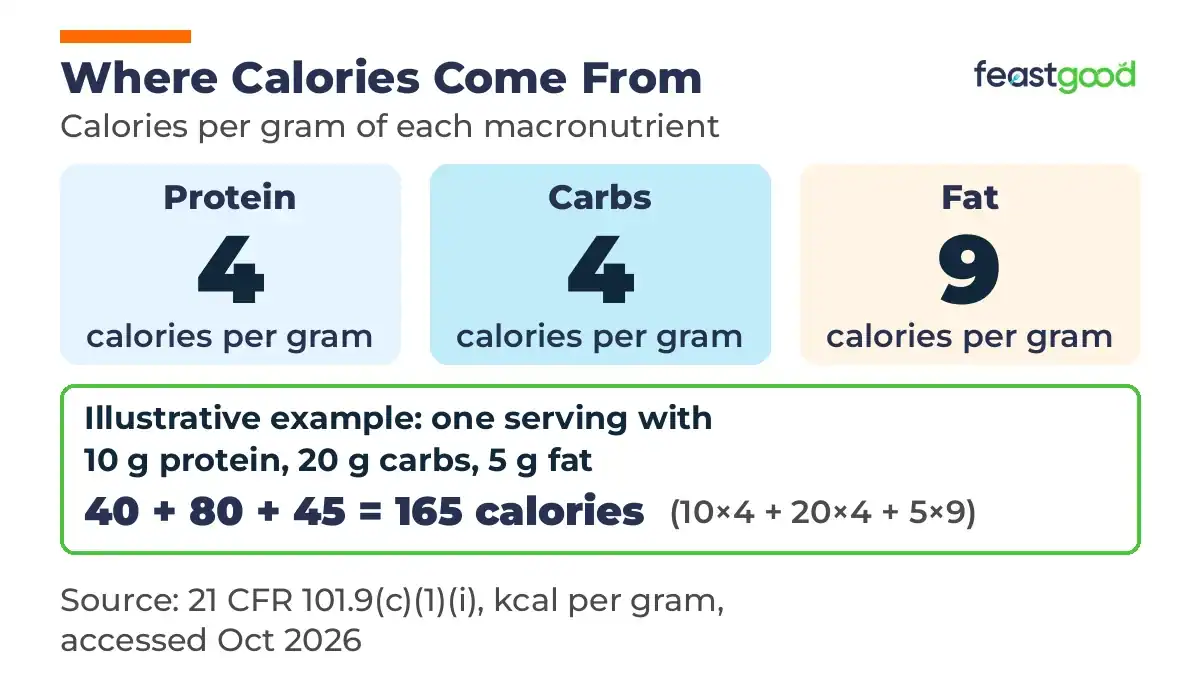
Calories come from three macronutrients:
- Protein: 4 calories per gram
- Carbs: 4 calories per gram
- Fat: 9 calories per gram
Here’s a made-up example to show how that works. Say a snack has 10 g of protein, 20 g of carbs, and 5 g of fat per serving:
- Protein: 10 × 4 = 40 calories
- Carbs: 20 × 4 = 80 calories
- Fat: 5 × 9 = 45 calories
- Total: 165 calories per serving
If you eat two servings, that’s 330 calories. You don’t have to do this math every time. Your app does it for you. But knowing it helps you spot an entry that doesn’t add up.
Step 3: Weigh It or Estimate It
A food scale takes the guessing out of portions.
At home, weigh your food in grams and log that exact amount. You don’t have to weigh forever. Do it long enough to learn what a real portion looks like.
When you can’t weigh something, make your best estimate and log it anyway. An estimate beats a blank entry.
Step 4: Log It in an App
A pen and notebook can work, but an app does the math for you. You scan a barcode or search a food, enter the amount, and the app adds it up.
That’s why I recommend MacroFactor. It has a verified food database and a barcode scanner, plus micronutrient tracking and no “shaming” red numbers when you go over.
As of October 13, 2026, MacroFactor costs $71.99 a year, $47.99 for six months, or $11.99 a month. There’s no free version, so start with the trial.
Check Out MacroFactor App Start with a free 7-day trial plus an extra week with code FEASTGOOD.
Want a free app instead? See my picks for the best calorie trackers for beginners and this free calorie tracker guide. For a bigger roundup, see my picks for the best macro tracking app. And if MacroFactor turns out not to be your style, here are the best MacroFactor alternatives.
Whichever app you use, here’s how to handle the four situations you’ll run into every week.
Barcode or Label vs Database Entries
When you have the package, scan the barcode or copy the numbers straight from the label. That’s your most reliable entry.
When you search the database instead, pick a verified entry if your app marks them, and check that the serving size matches what you ate.
This matters more than people think. Nothing annoys me more than taking the time to log all my food and then having the numbers be off. If the database isn’t accurate, what’s the point of logging at all?
Recipes and Homemade Food
For anything you cook, log the ingredients once as a recipe, then log your portion of it. Weigh the finished dish if you can, so your portion is a real share of the whole.
Here’s a step-by-step guide to counting calories in homemade food.
Eating Out or No Label
At a restaurant or a friend’s house, you won’t get it exact. Pick the closest entry or make your best estimate, log it, and move on. Here’s how to count calories without labels.
Quick-Add for the Days You’d Otherwise Skip
Some days I just don’t want to search for every food and adjust the portion size. Having a faster way to log is often the difference between logging my food and saying, “Forget it.”
If your app has a quick-add option, use it on those days. Enter your best estimate of the calories and keep the day complete.
Step 5: Log the Whole Day, Not Perfectly
Your log will never be perfect, and that’s fine.
Even food labels aren’t exact. They’re legally allowed some variance, so the calories on the package and the calories in the food can differ.
What matters more is logging the whole day. The one thing that really throws off an adaptive app is logging breakfast and then forgetting the rest of the day. The app has no way of knowing you ate more. As far as it can tell, breakfast was all you ate, so it bases its math on that.
So if you have a messy day, log it anyway, even if some entries are rough guesses. A rough log of the whole day beats a perfect log of one meal.
Step 6: Read Your Weekly Average and Trend Weight, Then Adjust
Your weight goes up and down from day to day, and that’s normal. One weigh-in doesn’t tell you much.
Instead, judge by the week. Look at your average daily calories for the week and the overall direction of your weight, not any single day.
If your weight is moving the way you want, keep going. If it isn’t, wait until you’ve logged consistently for a few weeks, then make a small change to your target.
This is where an adaptive app helps. MacroFactor estimates how many calories you burn from what you log and how your weight changes, then adjusts your targets each week. You don’t have to work out the change yourself.
What About Macros?
Calories come from protein, carbs, and fat, so once logging calories feels easy, tracking those three is the natural next step. Here’s how to track macros. If you’re not sure you need to, compare macro vs calorie counting.
When Tracking Stops Helping
Tracking is a tool, not a test. If logging starts to make you anxious or takes over your day, step back. Here’s how to count calories without getting obsessed.
This is general guidance, not medical advice.
The Bottom Line
Tracking calories isn’t about perfection. Get a rough target, read the label, weigh or estimate your food, log the whole day, and judge by your weekly trend.
If you want an app that does the math and adjusts your targets for you, MacroFactor is my pick. Want the full tour first? Read my MacroFactor review.
Check Out MacroFactor App Start with a free 7-day trial plus an extra week with code FEASTGOOD.
References
- U.S. Food and Drug Administration. How to Understand and Use the Nutrition Facts Label. https://www.fda.gov/food/nutrition-facts-label/how-understand-and-use-nutrition-facts-label
- Code of Federal Regulations, 21 CFR 101.9, Nutrition labeling of food. https://www.ecfr.gov/current/title-21/chapter-I/subchapter-B/part-101/subpart-A/section-101.9
- Burke LE, Wang J, Sevick MA. Self-monitoring in weight loss: a systematic review of the literature. J Am Diet Assoc. 2011. https://pubmed.ncbi.nlm.nih.gov/21185970/
- Burke LE, et al. Using mHealth technology to enhance self-monitoring for weight loss (SMART trial). 2012. https://pubmed.ncbi.nlm.nih.gov/22704741/